

Revealing the foundation of all existence
By: Rabbi Dovid Samuels
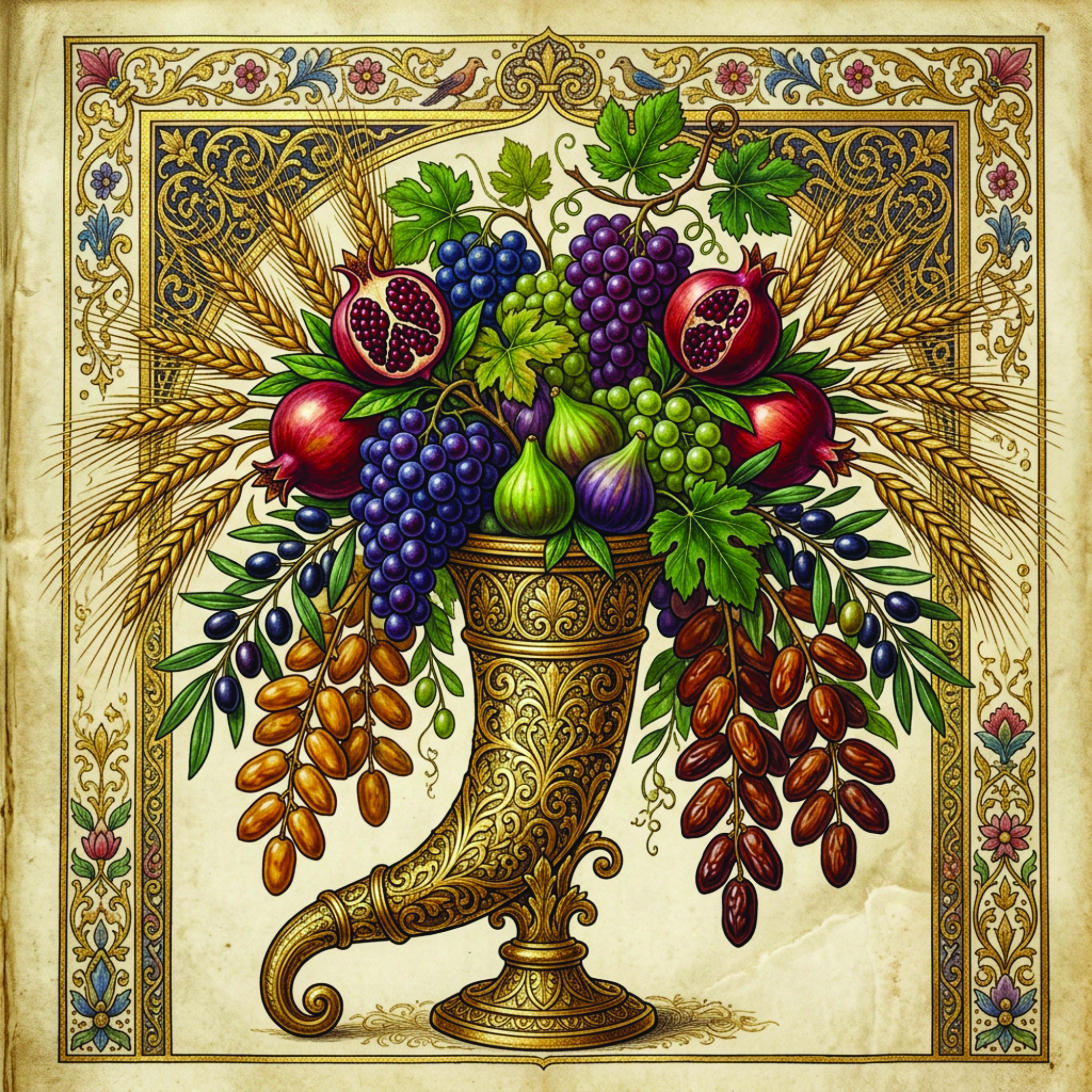
The Yom Tov of Matan Torah was given two distinct names in the Torah – ‘Shavuos’ and ‘Bikkurim’. As it says[1]: “And on the day of the Bikkurim (first fruit offering), when you bring a new mincha offering to Hashem on your Shavuos.” Similarly, the Torah describes the omer-count leading up to the Yom Tov and culminates with the commandment to bring “two loaves of bread… the first-fruits to Hashem”.[2] Now, one can certainly understand why Shavuos is called ‘Shavuos’. A Shavua is a week, and the Yom Tov is the fiftieth day following a count of seven weeks. But “Bikkurim” refers to the mitzvah to bring one’s first fruits to the Beis Hamikdash. What does the day of Matan Torah – the lofty, exalted day on which the bris between Hashem and His people was forged – have to do with first-fruits?
To explain the connection, the Sfas Emes[3] starts with a fundamental principle: There is a connection between the 10 utterances through which Hashem created the world, and the 10 commandments given at Har Sinai. Both of these sets of ten are ingredients in the creation of the world, as the root core of everything is found in the Torah with the ten commandments, and that root core becomes a reality through the process of the 10 utterances. In other words, the Torah is the root of all life and the foundation of all existence. The Divine energy embedded in the foundation of creation does not merely animate it at the moment of its formation – it continuously renews and sustains every created thing, at every moment, without pause. The basis for the ongoing renewal and continued existence of every single creature is also rooted in Torah. Torah preceded the world, and the world was created through it – yet until Matan Torah, this fundamental concept remained concealed and hidden. It wasn’t clear to humanity until that point how the world was being sustained. But when Hashem revealed Himself to His people with the giving of His Torah, suddenly there stood before them the awesome reality: the Torah is what vivifies and renews the existence of everything in our world. With Matan Torah it became clear that there is no such thing as simple ‘nature’ operating independently. There is only the power of Torah, which is the word of Hashem, giving life to all things and governing all things. Thus, on the day of Matan Torah, the origin-point that sustains and maintains the entire world was laid bare.
“There is only the power of Torah”
With this, the name ‘Chag HaBikkurim’ becomes perfectly self-explanatory. Shavuos is the day of ‘first-fruits’ in the most fundamental sense: the day of beginning, the source, the starting-point of all creation and all existence; the day of the Torah.
Shavuos arrives at the culmination of a seven-week process during which the hearts of the Jewish people were prepared and refined following their departure from Mitzrayim. At the conclusion of those seven weeks of purification and elevation, we too are expected to arrive at the recognition that every created thing is guided by Divine Providence. This recognition is the inevitable, organic outgrowth that blossoms within a person at the pinnacle of the three stages of emunah:
First: every single thing, from the very first moment of Bereishis until the very last, was created and brought into being from nothing – yesh me’ayin – through the utterance of Hashem. Second: without the continued reverberating utterance of Hashem sustaining it, every created thing would revert to nothingness in an instant. Hashem, therefore, did not merely create the world at the outset – He actively and continuously sustains every single thing at every single moment. Without Him, everything returns to nothingness. This is why “ein od milvado” – there is nothing other than Him – and even the Yetzer Hara cannot exist without the utterance of Hashem sustaining it. Third: since Hashem sustains every single thing at every single moment, it is totally self-evident that He is also watching over and attending to everything that happens with each creation, for good or for otherwise.
It is from this understanding that our belief in hashgacha pratis – Divine providence – flows. But let us go further in explaining how this day exposes the Source in everything.
“We literally owe our lives to the Torah.”
The korban brought on Shavuos is comprised of the Shtei HaLechem – two loaves of bread waved before Hashem. These two loaves represent the fact that there are two distinct types of sustenance in this world: there is bread that descends from heaven – as the manna descended in the desert – and there is bread that man “brings forth from the earth” through his own toil and effort. The Chiddushei HaRim[4] explains that there is heavenly bread that is entirely independent of man’s deeds, flowing purely from the chesed of Hashem, and there is earthly bread that is contingent upon man’s actions, granted in direct correlation to the quality of his conduct. Both loaves together must be waved upward – lifted toward heaven – as an acknowledgment that even what man apparently produces “from the earth” is, in truth, the fruit of Divine providence, which sustains him at every given moment. So, the ‘Chag HaBikkurim’ becomes the occasion on which Hashem’s providence over His world was revealed, and the Torah as the source of all existence became apparent.
The Sfas Emes adds a further layer of explanation as to why this Yom Tov is also called ‘Shavuos’. The word ‘shevuah’ not only means ‘a week’, but it also means ‘an oath’ – for every Jew became bound by a standing oath from Har Sinai. Our obligation to keep the Torah is in the nature of a shevuah – an oath we all took. But what exactly is the nature of this oath? The Sfas Emes explains that just as the Torah is the life-force of the entire world, it is also the very life-force of the Jewish people. But this is not merely because Hashem gives life to all things through His word, which is the Torah. It is far deeper than that. There is something particular about the Torah that makes its observance an existential imperative for the Jewish people, rooted in the very source of their being. And this stems from what transpired at the actual moment of Kabbalas HaTorah.
Chazal teach us that at the moment the Torah was given, the souls of every Jew literally departed from them, overwhelmed by the sublimity of the revelation and the Divine visions that were revealed to them. It was only due to the fact that we agreed to be guardians of the Torah that we were granted life again. Thus, by dying at Har Sinai, and being revived with the Torah, the Jews are only alive by virtue of the Torah. We literally owe our lives to it. Had the Torah not interceded to restore our souls, we would have ceased to exist altogether. Now, when a person takes an oath, he stakes the entirety of his life-force on the truth of that which he swears by. An oath concentrates and focuses every ounce of a person’s vitality upon the thing he is swearing to uphold. It follows, therefore, that since the Torah is the very foundation of Klal Yisrael’s existence, the Torah is, by its very nature, a shevuah – an oath – to which we stand perpetually bound.
But there is still one more step: without Torah our souls would have left us at Har Sinai and not returned. But it is not only the soul of a person that emanates from the Torah; even the physical dimension of a person also carries an element of kedushah, sustained by the Torah. This is the meaning of the teaching of Chazal[5]: “I created the Yetzer Hara – and I created Torah as its antidote.” For it lies within the power of Torah to exert influence even over the physical dimension of man, which owes its very existence to the Torah. So as the source of both our spiritual and physical elements, within the Torah is hidden the power to restore and return a person’s purity even after he has already experienced physical failures due to the enticements of his evil inclination.
“No mitzvah is needed to elevate the physical – on Shavuos, it is already elevated.”
On Shavuos, all of creation and the natural order are nullified and drawn back to the root of their life-force. It is the day of the revelation of Hashem’s governance over His world, on which it was made manifest that every single thing is renewed and sustained through the Torah. It is the day of the revelation of the Divine source of everything, constantly, and for that reason it bears the name Chag HaBikkurim. On Sukkos and Pesach, we have objects to perform mitzvos: the lulav, the matzah. But on Shavuos, there are none. As the day where every single thing is defined by its source, when the Torah transforms everything in creation into a holiness, no mitzvah is needed to elevate the physical…it is already elevated! It is also called Shavuos – in the language of an oath – because we stand perpetually bound, from Har Sinai, to uphold the Torah. Why? Because through the Torah we are alive, and it planted within us the power of existence for both our spiritual dimension and our physical dimension alike. Matan Torah is the gift of life to the human being in his totality – spiritual and physical – and from here flows the power of Torah to infuse kedushah into the material dimension of man, to draw it back to its source, and to unite even our physical actions to Hashem.
Bamidbar 28:26 ↑
Vayikra 23:15–17 ↑
Rabbi Yehudah Aryeh Leib Alter (1847–1905), known universally by the title of his famous work, the Sfas Emes, was the second Rebbe of the Ger Hasidic dynasty and one of the most influential figures in modern Chasidic thought.
The grandfather of the Sfas Emes. ↑
Kiddushin 30b ↑