

The Lamb Leader
By: Rabbi Moishe Schnerb
As we array ourselves around the Seder table on Pesach night, we open our well-worn, wine-stained and crumb-littered Haggados to once again read and discuss the account of our forefathers, and indeed our sojourn through the trials and travails of our Egyptian exile.
After the opening preliminaries of Kiddush, and the tiniest sliver of food – just enough to remind us how hungry we actually are – we begin the recital of these time-honoured paragraphs. Ma Nishtana piques our curiosity as to what makes this night so unique and different from so many other celebratory feasts that we, as a Jewish nation, are privileged to participate in. We are told how important it is for us to revisit, relate and depict in the most vivid and expressive way the myriad experiences we were exposed to in that exile.
We are then told how even the greatest of our Sages, who as far as we might be concerned knew everything, still made the effort to exert themselves and properly delve into the intense analysis of what this night is all about.
We then declare that whether we are connected or distant in our relationship to Hashem, we are still duty-bound to perform all the rituals of this night. We are encouraged to make the most of this opportunity and imbibe for ourselves the principles and basic tenets of our unshakeable and immutable faith and trust in Hashem.
Finally, we arrive at what is really the main part of our discussion: telling the story dating back to our great forefathers, and eventually ending up in the straits and strictures of Egyptian slavery. The tide turns, and Hashem, remembering His commitment and love for us, brings earth-shattering and teeth-jarring afflictions and miraculous punishments upon our tormentors, and finally, with raised hands and outstretched arms, we are carried on the wings of eagles out of Egyptian control.
There does, however, seem to be one major component – seminal in the events leading up to and orchestrating the entire process – that appears to have been overlooked. We all understand that it was Hashem who brought us into slavery and, when He saw fit, emancipated us. But what about Hashem’s trusty assistant (not AI), Moishe Rabbeinu? He is completely absent from the Haggadah and in fact makes only a cameo appearance in the penultimate word of a verse that the Haggadah brings to demonstrate the vast quantity of miracles that afflicted the Egyptians both in Egypt and at the Reed Sea. To exclude any mention of Moshe from the Haggadah is like a chicken soup without chicken, or a symphony orchestra without a maestro.
Let us therefore spend a minute or two discussing the role of Moshe Rabbeinu and the impact he made as the efficient right-hand man of Hashem.
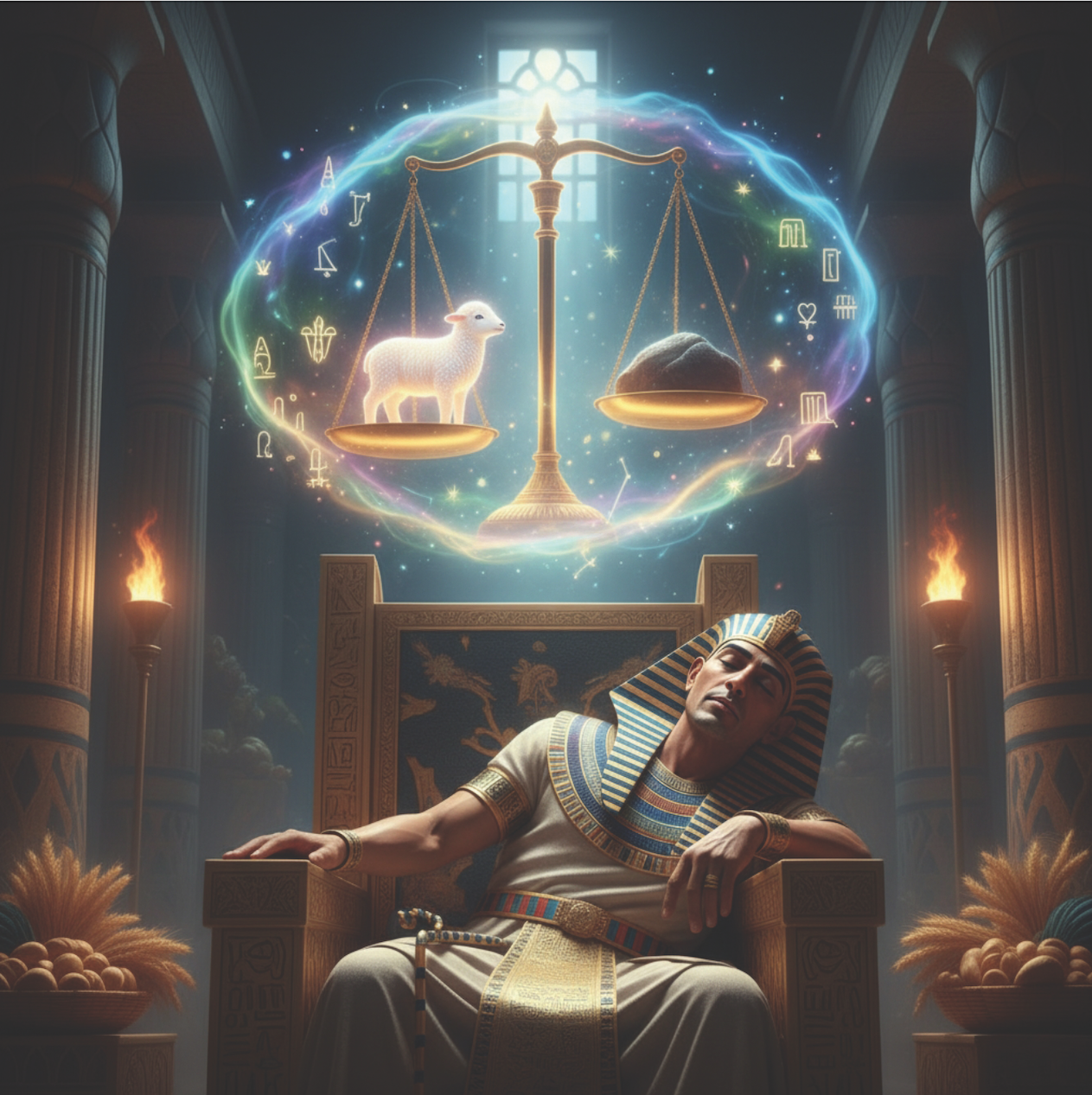
In the Targum of Rabbi Yonasan Ben Uziel[1], he records that one day King Pharaoh had a dream and saw an old man standing before him holding a scale. He placed the entire population of Egypt – men, women and children – on one side of the scale, and on the other side placed a solitary lamb, and the lamb outweighed the entire citizenry of Egypt. He awoke with a fright and could not fathom what this meant. He summoned all of his wise men and all of his magicians and told them the dream. They too were utterly confounded, until two wizards approached the king. Their names were Unis and Umbris, disciples of the great soothsayer Bilaam. They offered the following interpretation: a terrible and frightening event is going to occur in Egypt – a solitary child is going to be born to the Jewish nation, and he is going to bring destruction upon the entire land of Egypt.
We need to understand why Moishe Rabbeinu, who eventually triumphed over the Egyptian nation, is compared to a lamb.
There is a Medrash[2] commenting on a verse in Yirmiyahu[3]: “Israel is a scattered lamb, harmed by lions.” The Medrash explains that the Jews are compared to a lamb because just as when a lamb is struck or hurt on its head or limbs its entire body is racked with pain, so too with the Jewish nation – if one Jew is suffering, the entire nation feels and is sensitive to that pain.
“He set his mind and heart to share their distress.”
“His entire focus was: how can I participate in their pain and carry the burden together with them?”
The greatness of Moshe is epitomised by two words mentioned at the very beginning of his career, where the Torah says, “Moshe went out and saw their suffering.” Rashi comments: “He set his mind and heart to share their distress.” When Moshe came face-to-face with significant events, his attitude was never merely to witness curiously what was going on; his entire focus was: how can I participate in their pain and carry the burden together with them? Rav Chaim Vital says that it was in the merit of this attitude that Moshe was elevated to the role of Jewish leader, and therefore he is compared to a lamb.
The Torah in Parshas Vaeira states: “Hashem spoke to Moshe and Aharon and issued a command to the Jewish nation and to Pharaoh the king of Egypt, to emancipate the Jewish nation from Egypt.” At first glance this verse seems almost impossible to understand. We can certainly comprehend that Moshe and Aharon would be sent to compel Pharaoh to set the Jews free, but what does it mean that such a command was also issued to the Jewish nation? How could the Jews release themselves from the land of Egypt? We have an old dictum that no prisoner is able to free himself from gaol. Secondly, it seems strange that the edict to the Jewish nation is placed before the command to Pharaoh. What is the significance of that?
Explains the Meshech Chochmah: as surprising as it might seem, even in the midst of the terrible Galus Mitzrayim, there were amongst the Jews some wealthy businessmen, and those well-heeled gentlemen actually purchased Jewish slaves from the Egyptians and proceeded to make them work as their own personal slaves. Therefore, Hashem instructed Moshe to make his first stop with these people, even before proceeding to Pharaoh. They needed to be told in no uncertain terms that if you want Pharaoh to emancipate the Jews from the servitude of Egypt, it is first incumbent upon yourselves to free your slaves and stop subjugating other people. We know that Hashem operates on the principle of middah keneged middah – if you free your slaves, then Pharaoh will free you. That is why the instruction for the Jews to free their own slaves was an absolute prerequisite before Moshe and Aharon could even attempt to approach Pharaoh.
This also explains why the Torah says, “And I also heard the cries of the Jewish nation.” Why does the Torah add the word “also”? Did someone else besides Hashem hear the cry of the Jewish nation? The reality is that when Hashem observed those wealthy Jews who had themselves been taking advantage of and enslaving other Jews, and who – as a result of Moshe’s impassioned plea – were sensitive enough to recognise where they had erred and freed their own slaves, this became a catalyst for Hashem to hearken to the cries of the suffering nation as a whole. That is why it says “also” – because once Moishe Rabbeinu succeeded in inculcating into the Jewish nation a deep compassion for the suffering of others, this facilitated a reciprocal reaction from Hashem, evoking His sensitivity to the plight of the entire Jewish nation. Moshe Rabbeinu was truly the “lamb” – who not only keenly felt the troubles and suffering of his brothers himself, but was able to teach and model that to the Jewish nation.
The Chasam Sofer was once asked for advice on how best to deal with the tremendous test of challenges in earning a livelihood. He responded that the best advice anyone could give was contained in the Torah itself: to help support and look after those who are even more desperately in need than oneself. The questioner objected, arguing that if the Rov would give him a blessing to become successful, he would then be ideally placed to help other indigents – but that currently this would be impossible. The Chasam Sofer demurred and responded that if we adopt the philosophy of “also” – making every effort to alleviate the suffering of other Jews – this will trigger within Hashem a desire to reciprocate and alleviate our own suffering. This was the model, the life lesson, that Moshe Rabbeinu understood would be most vital in bringing about the salvation of Klal Yisroel.
In the winter of 5675–1915, during the First World War, the Gerrer Rebbe, the Imrei Emes, made truly yeoman efforts to help thousands of Jewish refugees who had gravitated to Warsaw, even though he himself was in very dire straits. He passionately felt that the needs of all his fellow Yidden came before his own. During that period, one of his Chassidim presented him with a small challah in honour of Shabbos, which the Chossid had risked life and limb to bake as a tribute to his Rebbe. When the time for the Shabbos meal arrived, many had assembled to be near the Rebbe. The Rebbe cut the challah into small slices and distributed them to all those present. The benefactor objected and insisted that the challah had been intended for the Rebbe himself to eat on Shabbos. The Rebbe then explained as follows.
The Gemara[4] states that there is a bird called the chasida – literally, a righteous one – because it acts with great generosity towards all of its fellow birds and shares all of its food with them. There is another source in the Yerushalmi[5] which speaks about mice, and the Gemara labels them as reshaim – evil – because when they discover a large cache of food, they call together all of their companions to share the treasure. The Rebbe asked: what is the distinction between the chasida, who is labelled righteous, and the mice, who are called evil, given that both appear willing to share what they have with others? The Rebbe explained that there is indeed a vast difference between them. The chasida, upon seeing food, immediately summons the whole clan to come and enjoy the bounty. The mice have a very different approach: when they discover a large trove of food, they first ensconce and hide away a large portion for themselves, and only then share what remains with the others.
The Baal HaTurim notes that a particular phrase appears only twice in the entire Torah. In Parshas Noach it says that the land was full of theft and then in Parshas Sehmos, after recording that the Jews merited a miraculous population growth, it says, “and the land was filled with them.” He explains that the generation of the Flood perished because of their selfish and entirely narcissistic lifestyle, which directly led to the annihilation of all mankind. In contradistinction, as a result of the care, concern and sensitivity that the Jews exhibited towards one another throughout the period of the Egyptian exile, they merited their meteoric population explosion.
“Moshe the Lamb spawned the Lion of Yisroel.”
Moshe Rabbeinu’s name barely appears in the entire Haggadah of Pesach. This is because, although Moshe Rabbeinu was the leader who – together with his brother Aharon – acted as the public face of the Jewish nation, negotiating with Pharaoh and administering many of the plagues that crippled and ultimately, at the Reed Sea, destroyed the Egyptians, the real leadership that Moshe Rabbeinu provided was not as a charismatic public figure whose rhetoric, patriotic fervour and bombastic declarations made his name and fortune in the world. The true greatness of Moishe in his role as the undisputed and pre-eminent commander-in-chief of the Jewish nation was his role as a pedagogue and exemplar, who taught the Jewish nation the elite character traits of kindness and compassion that were the very triggers for their eventual resuscitation and establishment as the Am Hashem. Moshe the Lamb spawned the Lion of Yisroel – a nation capable of experiencing redemption, receiving the Torah, Hashem’s special treasure, and ultimately settling in Hashem’s home, Eretz Hakodesh, with its nexus on the mountain of Tzion.