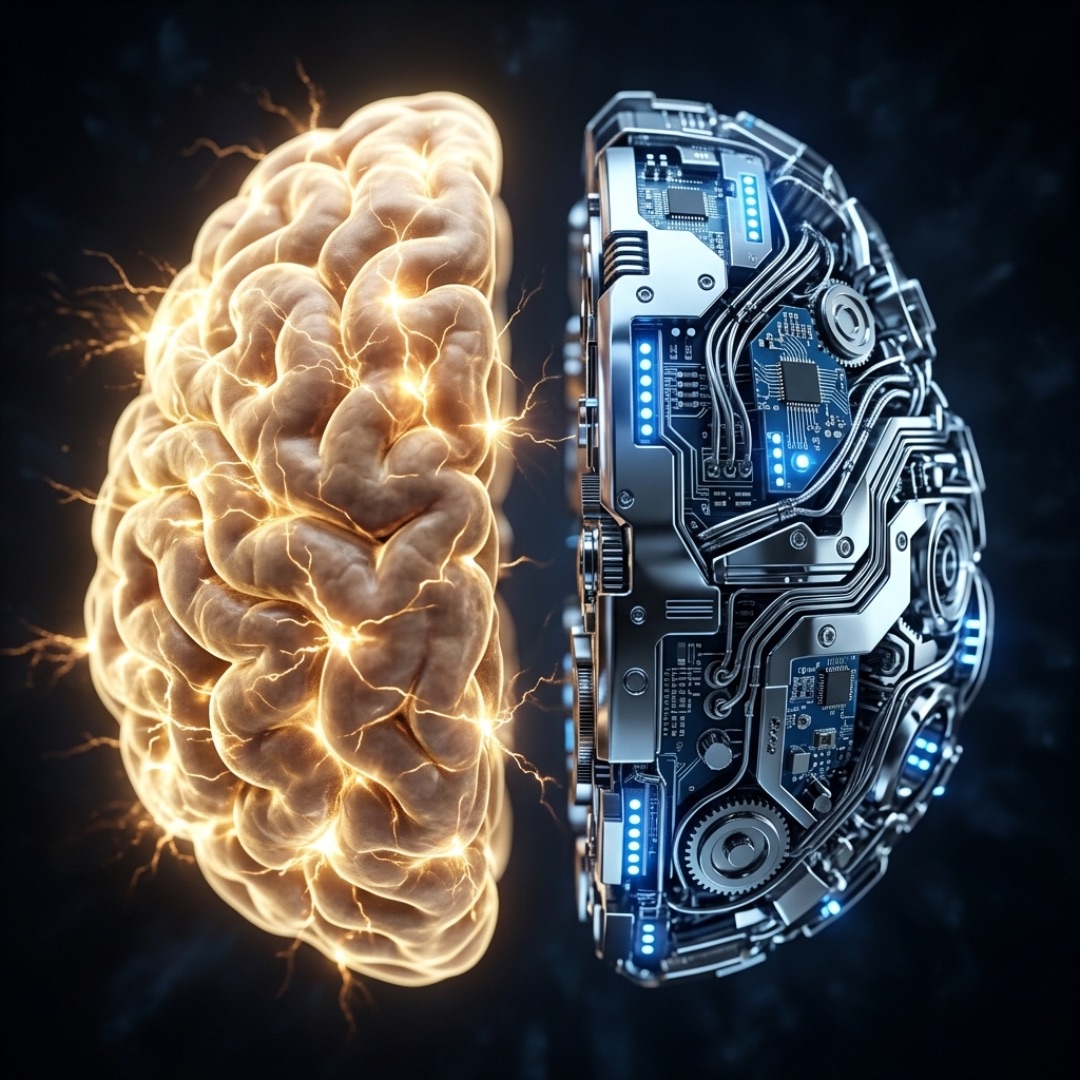
Rabbi, engineer and AI ethicist Rav Mois Navon on why Artificial Intelligence is asking questions humanity has never had to answer before
By: Ilan Preskovsky
Like all the best overnight sensations, artificial intelligence has quietly been toiling away in the background for years before everyone, seemingly at once, turned around, noticed it, and kicked it straight to the top of the proverbial charts – which in this case means making it the defining trend of the 2020s, bar none. And that’s really saying something when you consider all the insanity that has happened in the world just these past six years.
Artificial intelligence certainly isn’t new and it has quietly been impacting our lives since the term was first coined way, way back in 1956 by computer scientist John McCarthy (thanks, Gemini!), but it would be disingenuous to suggest that it hasn’t really stepped up its game over the past decade or so. The so-called “deep learning revolution” in the late 2000s through mid-2010s, in particular, gave rise to what most of us think of when we think about AI: generative AI, which mimics human creativity, and highly advanced chatbots – or LLMs (large language models) – which mimic the complexities of human language.
And heaven help us all.
Or maybe not? As someone who not only writes for a living but frequently writes about the creative arts, my knee-jerk reaction to these particular trends is something in the vicinity of “kill it, kill it quick, before it kills us!”, but I may be being a bit rash. Artificial intelligence in its current (and still nascent) incarnation is, after all, an inordinately complicated subject and its potential uses range from curing cancer to, well, Terminator 2: Judgement Day.
So, when I sat down for a WhatsApp call with Rav Mois Navon, an ordained Orthodox rabbi, engineer, and a leading expert in the ethics and philosophy of AI, I was all too aware that any serious discussion about AI – even just the areas in which he has particular expertise – would take days, not minutes; multiple academic tomes, not a couple of pages in a magazine. This was clear just from attending one of his thought-provoking shiurim when he visited our shores as Yeshiva Mizrachi’s visiting “scholar in residence” this past Shavuot.
But we have to start somewhere and my utterly fascinating conversation with Rav Navon was a very, very good place to start.
A Bit of Background
Rav Navon was born and raised in Los Angeles in a traditional but not particularly observant family. When trying to decide what to major in at university, the young Mois Navon was convinced to take up engineering by a family friend who worked in the field and who also promised him a job when he graduated, but as it turns out this friend wouldn’t just influence his career path, but his spiritual path as well. As a religious Jew, he introduced Mois to engineering, but also to Orthodox Judaism. While the former utilised his skills in maths and science, the latter was the answer to those universal questions he had been asking himself since he was a kid: why are we, as human beings, here on this Earth?
“LA is a fun place, so you can fill your mind with fun, and it sort of numbs the need for meaning,” Rav Navon explains. “But at the end of the day, you want to know why you are here. And that’s the task of religion. And this [family friend] said, there’s a purpose. You’re here to fix yourself. You’re here to fix the world.”
Such an idea resonated deeply with him and along his spiritual journey he started going out with a girl from a similar background going through a similar journey. A few years later, when the couple were married with two young children, she suggested, “you know, if we want to do this Jewish thing, we need to go to the land of the Jews,” so they did. He started off in Israel working for IBM and then moved on to different tech start-ups before ultimately ending up as one of the founding engineers at Mobileye, a company that would prove to be a major pioneer in the field of self-driving cars. During his sixteen years at the company, he also spent six years at Yeshivat Mercaz Harav and received semicha from Rabbi Zalman Nechemia Goldberg.
Rav Navon also attended Bar-Ilan in 2017 and completed a master’s in Jewish philosophy. When the time came to decide on a subject for his PhD thesis, though, he was – like his younger self choosing a major – completely stumped. He first considered doing a paper on Rabbi Joseph B. Soloveitchik, but was told, not too surprisingly, that the subject of the great Rav Soloveitchik had been well and truly covered. But, while grappling with his PhD, he happened to give a lecture on autonomous vehicles and the famous “trolley problem” when he was approached by a student who asked him when he thought artificial intelligence was going to become sentient.
To Rav Navon, the whole thing seemed self-evident: obviously it wasn’t going to become sentient. “Sentience means that you experience the world. Sentience, at the end of the day, means you have a soul. There’s an animal soul, there’s a human soul, but there’s not a machine soul.” While he tried to shape his thoughts on the matter into a drasha that he could deliver at shul, the more he thought about it, the more it gnawed at him. He decided it was simply much too large a subject for a short drasha and decided that it would be the perfect subject for his thesis.
“I wrote about what’s called the moral status of artificial intelligence from a Jewish perspective,” Rav Navon explains. “Basically, what the dissertation asked was: what’s the status of this thing that looks like us, acts like us, talks like us? At the time, it was completely theoretical, and I was working [on the basis of] social robots. Nobody had any idea that chatbots would go live way before social robots. But everything I wrote in my dissertation is 100% applicable to chatbots today.” Rav Navon has been tackling these, and many other questions, ever since.
AI and Consciousness
You don’t need to have a doctorate in philosophy, though, to realise that the rise of the current version of AI poses new challenges to what we know about consciousness – or more precisely, don’t know. The question of what consciousness is, how it arises, and how it works, especially in relation to our physical brains (or, as it is known, the mind-body problem) has been a subject of serious discussion by philosophers and theologians for thousands of years and, however much the more strident materialist scientists like Richard Dawkins may insist that consciousness is just a by-product of complex cognitive processes in the brain, science itself barely knows how to ask the question, let alone answer it. Indeed, as Rav Navon says, strictly speaking, we can’t even really know if someone else has consciousness – I can only assume that you have it based on the fact that we are both similar biological creatures and, if I am self-aware, then you presumably are too. “It’s a crazy assumption,” Rav Navon admits. “I only have a sample of one. I only know myself. I can’t prove anybody else. Nothing else in science is based on a sample of one!”
“Sentience is just the secular word for having a soul. There’s an animal soul, there’s a human soul, but there’s not a machine soul.”
So, how does all of this fit into AI – especially if, as Rav Navon says, “sentience is just the secular word for having a soul”? It is, to say the least, complicated. Too complicated and too lengthy, in fact, to go into everything that Rav Navon said to me on the matter in our short chat. There are several schools of thought, including one that he personally subscribes to, which holds that to even begin talking about actual sentience, actual consciousness, we have to be dealing with something organic – a lab-grown brain, basically, which is something that scientists are actually working on, but certainly aren’t there yet.
If AI does ever become conscious, the ethical questions become immense, not least because, in effect, we could so easily end up creating a new kind of slave for humanity to exploit. Still, as Rav Navon stresses, AI doesn’t need to be sentient to raise some very serious ethical concerns; not in how we affect machines, but in how we allow them to affect us.
“If you’re going to treat something that really interacts with you like your mother, your friend, your wife, and then you start telling it to just shut up and give me the answer – that’s how you’re going to start acting with your mother, your friend, your wife.”
What Are We Becoming?
There is an idea in Judaism that how we treat inanimate objects has a direct effect on our character. Take, for example, the practice of covering the challah while reciting kiddush over wine – the reason for this, we are told, is so that we don’t “embarrass” the challah. Needless to say, a loaf of bread, no matter how well plaited, can’t actually feel embarrassed, but the point of this practice is to develop a certain sensitivity within us: that if we are careful not to “embarrass” something so lacking in anything even remotely resembling human consciousness, how much more so an actual human being! And if this applies to objects with no trace of recognisable human traits, what does that say about a chatbot that is able to have actual conversations with you? As Rav Navon says, “if you’re going to treat something that really interacts with you like your mother, your friend, your wife, and now you start telling it, you know, just shut up and give me the answer, then that’s how you’re going to start acting with your mother, your friend, your wife.”
I can’t imagine that many of us think that way when asking ChatGPT or Gemini a question, but it’s undoubtedly something of which to be cognisant, even vigilant. More common, and even more obvious a problem, though, isn’t that people are being dismissive of chatbots but that we may be forming unhealthy attachments to them.
“People are actually becoming friends with their LLMs.”
“People are actually becoming friends with their LLMs,” Rav Navon notes of a particularly alarming trend. “Mark Zuckerberg even said in an interview that ‘we are making [AI chatbots] to be your friend. People need friends and they don’t have enough of them and we want to make digital friends.’ And so they design it with what he called personalisation so that you’re locked in. You have a hard time rejecting it because it’s wired to have a relationship with you. It’s not just giving you answers.”
The problem with this, of course, is that even the most advanced chatbot is a poor substitute for a real human relationship – for many reasons, but not least because they’re designed to always give you positive feedback. They won’t call you out for a bad decision or hold you accountable for anything. “People push back and that’s how you grow up and learn to be a mature adult – you learn to compromise and to keep your mouth shut and not say everything that comes to the top of your head. But now with the machine, it’s all good. And you don’t learn to be a mature adult.” Worse, not only are many people forming friendships with their AIs, but some are even developing romantic attachments to them. Though the less said about that the better, I would think.
The other big issue that Rav Navon points to with AI in its current form is one of cognitive decline. Not of the chatbots or generative AI programmes, of course, but of those of us who rely on them. As our machines get smarter, there’s a real risk that we will become less capable as a result. Indeed, according to a recent study by MIT, it’s already happening.
Rav Navon notes that he has seen this himself as an educator. He would see students hand in papers that, as he puts it, “have big, beautiful words, but they say absolutely nothing – they’re gobbledygook. They use chatbots for their assignments because it does the job, but they’re not even learning to edit it.” For this reason, he has begun a policy of requiring a five-minute oral presentation in which students actually have to explain what it is they wrote.
And he doesn’t even blame them for this. “Human beings are lazy. And I’m not putting them down for this. We look for the easiest route and it makes us efficient, but at some point you have to ask whether we’re giving up our very humanity for it.” That, of course, is the ultimate question here. Can we use these advancements in AI to our advantage without paying for it with the very things that make us human? At this point, I’m not sure that even Rav Navon can begin to answer that question.