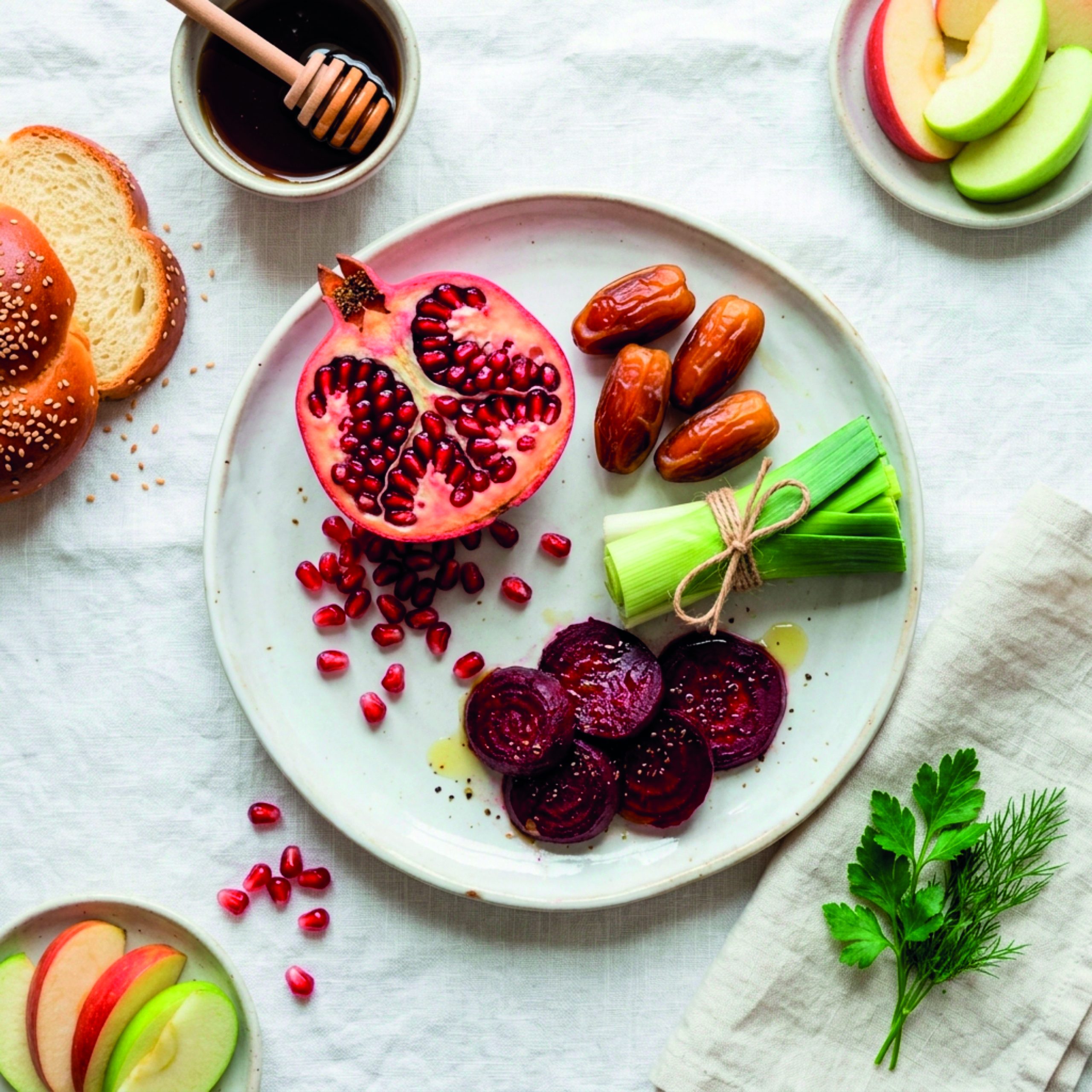
Picture the scene. It’s Rosh Hashanah night. The table is set beautifully, fine cutlery, round challah, and right in the middle sits a small plate of honey, apple slices, and a pomegranate. Someone passes the tray of dates and leeks. A child asks – probably not for the first time – “Why do we eat all this stuff?” The usual answer is something like: “It’s a siman – a sign for a good year.” And that’s true. But the Sfas Emes wants to take us much deeper. Because the real question isn’t just what the simanim mean. It’s why we express our wishes this way at all.
Wait – Does This Actually Work?
The Gemara[1] tells us something fascinating: signs and symbols carry real weight. “Simana milsa hi” – a sign is a meaningful thing. And so the practice was born: on Rosh Hashanah night, we eat foods whose names or qualities point to blessings we want for the coming year. The Shulchan Aruch spells it out. We eat dates (temarim), saying: “May our enemies be destroyed.” We eat beets (silka), saying: “May our adversaries depart.” We eat leeks (karshin), saying: “May our enemies be cut off.” We eat a pomegranate and ask that our merits multiply like its seeds. We dip apple in honey and ask for a sweet new year. We eat from the head of a sheep so that we should be a head, not a tail – and to recall the Akeidah of Yitzchak.
Beautiful. Meaningful. But here’s where the Sfas Emes stops and asks a hard question. If I deserve a good year – I’ll get one, regardless of whether I eat a pomegranate. And if I don’t deserve one… will a piece of fruit really tip the scales? And either way – why don’t we just say what we want? Why hint through food when we could simply daven for parnassah, health, and a good year straight out?
The Day That’s Not About Us
The Sfas Emes turns to the Zohar for a striking insight. On Rosh Hashanah, he explains, we are not supposed to be davening for ourselves at all. Not for parnassah. Not for health. Not even for a good year in the ordinary sense. The entire tefilla of Rosh Hashanah is dedicated to one thing: the revelation of Hashem’s kingship over the world.
The Zohar makes this point sharply. Some people, it says, daven during the Yamim Nora’im the same way a dog barks – “Give! Give!” – wealth, forgiveness, health, life. And the nations of the world do the same. But that’s not what Rosh Hashanah is for. The tefillos of this day are about one thing: may Hashem be feared by all His creations, may the world recognise Him as King, may everything unite to do His will. That’s what we’re asking for. Think of it like this. Imagine you have a private audience with the King. Would you spend the time asking him to fix your leaky roof? Of course not – you’d speak about the kingdom, about his glory, about matters that befit a king. Your own concerns would feel out of place.
That, says the Sfas Emes, is Rosh Hashanah. It is a day entirely consecrated to Kevod Shamayim – The Honour of Heaven. And that’s why we don’t stand up in Mussaf and list out what we need.
So Where Does That Leave the Apple and Honey?
Here’s where it gets beautiful. The Sfas Emes explains that we are allowed to ask for our personal needs – but only b’remez, only through a hint, only subtly. And the way we do that is through the simanim. Imagine a close friend who truly loves you. He would never march up to you and demand: “I need you to solve my financial problems.” That would be crass. Instead, he might find a gracious, oblique way to let you know things are tough – trusting you to pick up on it, without making it the centre of attention. That’s exactly what the simanim are. We’re not ignoring our needs – we’re expressing them with tznius, with modesty and humility. We’re placing Hashem’s honour at the centre, and gently, quietly, almost in a whisper – we’re saying: we could use some help too.
As the Sfas Emes puts it: “Ribbono Shel Olam – what belongs to Kevod Shamayim is said clearly and explicitly in my tefillos. My own personal need? That’s mentioned only in passing, on the side, because I am secondary – not the main event.”
But Wait – Isn’t It Still Self-Centered?
A sharp reader might push back: even if I’m only hinting, I’m still thinking about myself. Even a subtle request for better parnassah is still… a request for better parnassah. Hasn’t the Sfas Emes just moved the problem, not solved it?
He anticipates this question, and his answer highlights a truly powerful idea. We are permitted to ask for gashmiyus – physical blessing – but only when it’s framed the right way: k’dei l’shares es HaMelech – in order to serve the King. This is actually embedded in the Rosh Hashanah davening itself: “Zochreinu l’chaim, Melech chafetz b’chaim” – “Remember us for life, O King who desires life.” We’re not just asking to live. We’re asking for life for Hashem’s sake.
The Sfas Emes explains: every gift Hashem gives us – health, livelihood, a home, a family – was designed to enable us to serve Him better. When Hashem grants our material request, He is in effect saying: “Yes, I’m giving you this so you can use it for something greater.” Physical wealth is the means; spiritual gain is the destination. Think of a soldier. A good soldier doesn’t daven to get a better rifle. He davens to win the war. The rifle is just a tool. On Rosh Hashanah, Malchus Hashem – the establishment of Hashem’s reign – is the cause we’re fighting for. Our personal needs are just the equipment.
What Does the Pomegranate Really Mean?
Here’s a question the Sfas Emes himself raises. Most of the simanim are clearly about physical things – parnassah, protection from enemies, sweetness. But the pomegranate siman is: “Yirbu zechuyoseinu k’rimon” – “may our merits multiply like the seeds of a pomegranate.” That’s a spiritual request. So if all the gifts we receive on Rosh Hashanah are really spiritual at their root, what exactly are we asking for?
This leads the Sfas Emes to one of his most profound principles: everything we receive on Rosh Hashanah – health, livelihood, the whole U’nesaneh Tokef list of “who shall live and who shall die, who shall be rich and who shall be poor” – is, at its ultimate source, purely spiritual.
The physical blessings of our year are downstream of a spiritual reality that gets determined on Rosh Hashanah. The gift starts as something entirely spiritual, and only as it flows down into our limited, physical world does it take on material form – parnassah, health, success. Rosh Hashanah is the “rosh” – the head – of that flow, before it has yet taken physical shape.
Rosh Hashanah Really Is the “Head”
Why is Yom HaDin called “Rosh Hashanah” – the head of the year? The Sfas Emes points out that this name is far more than a calendar term. The Gemara[2] teaches “risha gufah azil” – wherever the head goes, the body follows. The rosh – head – doesn’t just come first – it defines everything that comes after it. Rosh Hashanah is the spiritual “head” from which the entire year flows. Every blessing of the coming year – every good thing that happens to us in Tishrei, Cheshvan, Kislev, all the way through Elul – has its root in what is determined on this day. It is a day of extreme spiritual download. Pure, undiluted, holy energy. As it passes through the year and into our everyday lives, it becomes concrete – a raise, a refuah, a shidduch. But its true form, as it exists on Rosh Hashanah itself, is spiritual.
The Physical World as a Window
The Sfas Emes explains that the physical world we see around us isn’t the “real” world – it’s a reflection of a deeper spiritual reality. The Zohar says Hashem created the physical universe so that human beings could use it as a window into the spiritual world: the sun, the moon, the trees, the animals – all of them are remazim – hints – pointing upward. A high-voltage electrical current can’t be directly accessed – it would destroy whatever touches it. First, it has to pass through a transformer that steps it down to a usable level. Similarly, the spiritual energy of the higher worlds can’t be directly absorbed by a human being made of flesh and blood. It has to be “stepped down” into physical form first – into the things we can touch, taste, and experience.
Every physical thing in our world, then, is a kind of garment worn by a spiritual reality. Our parnassah is a garment worn by Hashem’s blessing. Our health is a garment worn by Divine vibrancy. The physical is always, at its root, a message about something higher. And this is why, even when asking for physical things, a Jew asks only b’remez – through a hint. Because the Jew understands that the physical thing isn’t the point. It’s the spiritual reality underneath it that matters.
So the next time you reach for that apple and honey, or arrange the simanim plate, or hear a child ask, “Why do we eat all this stuff?” – you have a real answer. The simanim aren’t magic. They won’t automatically rewrite our verdict in the Heavenly court. But they aren’t empty ritual either. They are an act of beautiful, Torah-true communication. They are the way a person who truly understands Rosh Hashanah expresses his deepest needs – not as demands, not even as outright prayers, but as the quiet, humble whisper of someone who knows his place before the King. The main message of the day belongs to Hashem: His kingship, His glory, His reign over the world. Our own hopes and needs sit at the table too – but modestly, tucked in beside a plate of pomegranate seeds, expressed in a whispered yehi ratzon.
That is what it means to stand before the King. And that is exactly what simana milsa hi really means. What we are destined to receive this year is dependent on how much spirituality we will reveal through those gifts. Hashem, give us spirituality, and let us see that spirituality become pure goodness in its physical form.