
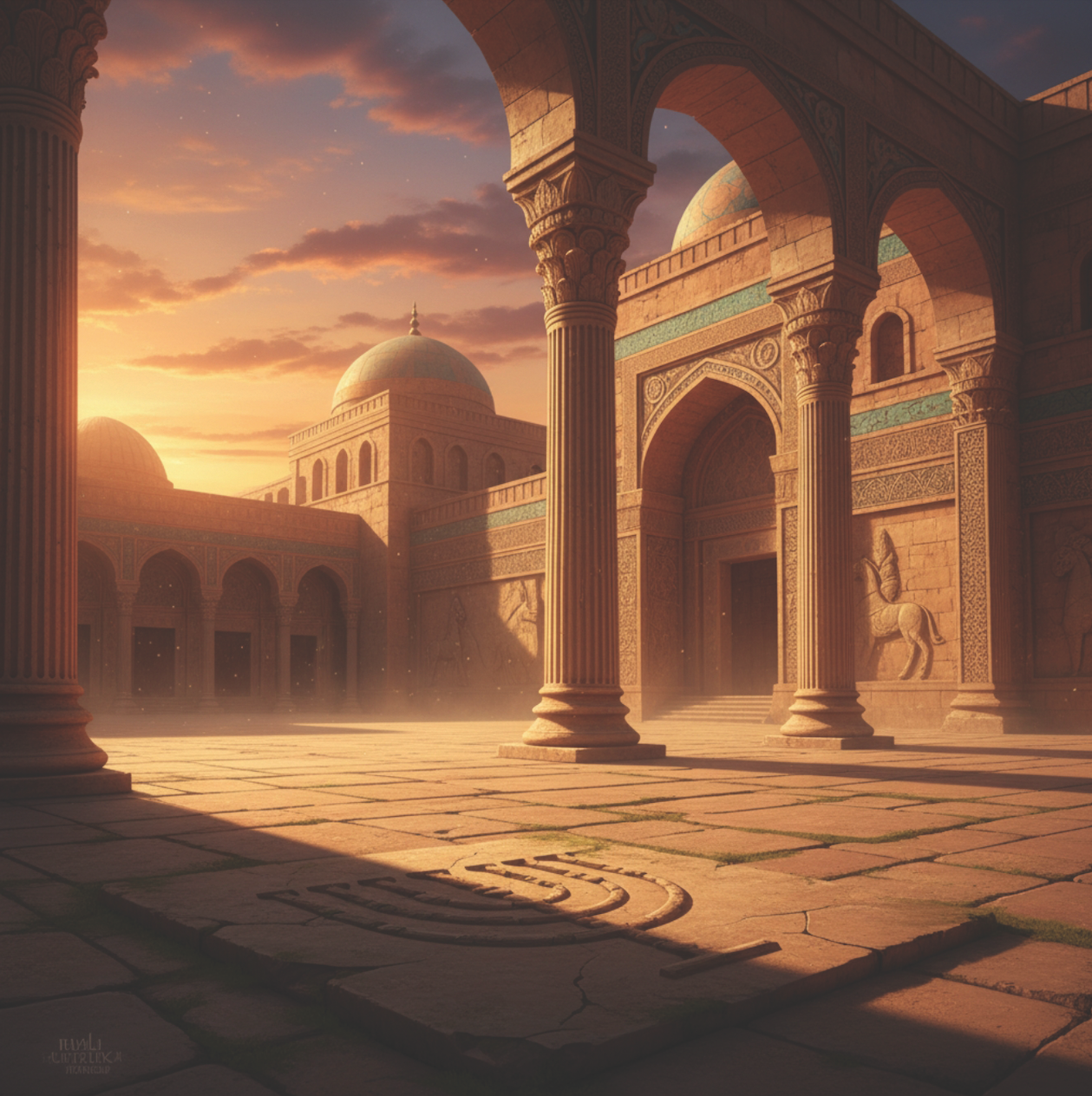
The “special relationship” between Jews, Iranians, and the Iran that once was
By: Ilan Preskovsky
It’s genuinely been quite astonishing to see the way the anti-Israel crowd is able to twist and distort any argument you throw their way. It’s almost always illogical, ignorant, and frequently outright nonsensical, but it’s impressive in a mental-contortionist kind of way. One of the more memorable recent examples of this is when, confronted with the – I would think – reasonable question of where all the “pro-Palestinian” activists and celebrities have gone in the face of the Islamic Republic of Iran massacring its civilians by the tens of thousands, they immediately turn it around and accuse Jews/Zionists/Israelis of pretending to care about Middle Eastern lives only when it suits us or, better yet, claim that Israel has stoked insurrection in Iran to deflect from the “genocide” in Gaza. Cute debate rhetoric. Abhorrent sentiment. An almost embarrassing lack of knowledge. So it goes.
“Jews have strong ties to Iran that have persisted for one thousand years longer than the entire existence of Islam.”
The truth, of course, is that Jews do, in fact, care about the lives of other Middle Easterners. Iran, though, is a particularly special case. First and most obviously, the Islamic Republic is the number one enemy of Israel, Jews, and the entire liberal-democratic order, so obviously the fall of the regime would benefit Israel and the region tremendously. But no less crucially, Jews have strong ties to Iran that have persisted for 2 700 years – or one thousand years longer than the entire existence of Islam.
Jews in Ancient Persia
It’s a relationship that goes back, quite literally, to Biblical times. Putting aside any previous trade relationships that might have existed between the Kingdom of Israel and Persia, we can trace the first example of Jews residing in what is now Iran to the book of Malachim Bet (II Kings 18:11), where it notes that some of the Jews of the Kingdom of Northern Israel were resettled in Medes, modern-day Iran, after being conquered by the Assyrian Empire in the 8th century BCE – the infamous story of the ten lost tribes.
More significantly, Jews started arriving en masse in Persia in the sixth century BCE*, as well as in lands that would later become part of the Persian Empire, when the Babylonian king Nebuchadnezzar II first conquered the Kingdom of Judea and began to exile its local population, which culminated in the destruction of the first Beit Hamikdash and what is known as the Babylonian Exile.[1]
When the Persian king Cyrus the Great conquered Babylon circa 539 BCE and began the reign of the first Persian Empire – or, as it is more precisely known by Cyrus’ dynasty, the Achaemenid Empire – he decreed that Jews were free from the bondage the Babylonians had placed them in and would be allowed to return to Judea and begin construction on a new Temple where the first one once stood. Thousands of Jews took the opportunity to return to their homeland and build the second Beit Hamikdash (which saw completion during the time of Darius, Cyrus’ successor), but the majority, who had built comfortable lives for themselves in this new civilisation, decided to stay.
Even with the major disagreement between Rabbinic sources and secular historians on the precise date of the Babylonian Exile and everything that followed, this entire narrative is corroborated by both extensive historical research and the Tanach itself. Megilat Esther, meanwhile, is set entirely within the Persian Empire, with the bulk of the story taking place in the capital city of Shushan (or Susa in Persian). Jews were in what is now modern-day Iran from the very beginning of the Persian Empire through to its end, and have remained so until today.
Bringing Us to the 20th Century
Maintaining a consistent and at times significant presence in Persia/Iran for the better part of three millennia means that, like the country itself – which bore the brunt of its fair share of historical turmoil – the quality of Jewish life in the country had its ups and downs. It would all depend first on which of the great empires was ruling the land at the time, as not every ruler would be a Cyrus – or, for that matter, an Alexander – the Great.
There would be three major Persian Empires (Achaemenid, and later, in opposition to Rome, the Parthian and Sasanian Empires), Greek rule (Alexander the Great’s Macedonian Empire), and the gradual establishment of Zoroastrianism – which is up there with Judaism and Hinduism as the world’s oldest surviving religion. The Sasanian Empire lasted some eight centuries and, though tensions between Jews and Zoroastrian religious leaders did arise, this whole period is marked as a particularly good time for Jews in exile, as the highly segmented nature of Sasanian society meant that Jews were generally left alone with a fair amount of autonomy. Indeed, the rabbis of the Babylonian Talmud lived and mostly thrived under Sasanian rule and within Sasanian society, and the Talmud itself was ultimately compiled towards the end of its 800-year reign.
The Sasanian Empire is generally considered to be the height of Persian civilisation, and its influence on science, the arts, and culture was so strong that when the country was first conquered in the Islamic invasion of much of the Middle East in the 7th century, Sasanian culture didn’t just persist in Persia but influenced Islamic civilisation itself. Inevitably, Islamic rule was a decidedly mixed bag for the Jews of Persia: they were always considered dhimmis, second-class citizens in Islamic lands, but how they were treated depended entirely on the severity of the Islamic ruler at the time, with periods of acceptance or at least tolerance being followed by periods of violence, persecution, and forced conversion, all the way up until the early 20th century.
The 20th Century: A Golden Age Followed by Ruin
After centuries of suffering the whims of Persia’s Muslim leaders, things suddenly and decisively improved for Iranian Jews in 1925 with the establishment of the Pahlavi dynasty and its first leader, Reza Shah, who sought to modernise and even secularise Iran and do away with the more extreme manifestations of religion. He passed reforms that outlawed the forced conversion of Jews to Islam and raised the status of religious minorities in Iranian society, effectively giving them rights equal or closer to those of their Muslim neighbours.
From his assumption of power in 1925 through to his death in – remarkably – Parktown, Johannesburg in 1944 (Allied forces occupied neutral but strategically important Iran in 1941 and, after frictions with the British and the Russians came to a head, the Shah agreed to abdicate his throne to his son Muhammad Reza Pahlavi and leave the country shortly afterwards), Reza faced his fair share of criticism and certainly had his flaws and his failures, but he transformed Iran significantly and turned it into one of the most progressive and multicultural societies in the Middle East.
It was under the new Shah, though, that Iranian Jews enjoyed their most prosperous period ever, with some 80% living comfortable middle-class lives and with numerous Jews holding political positions in the government. Inevitably, it wasn’t all smooth sailing: around the time of the creation of the State of Israel, the Shah did have to contend with opposition from members of his government and the clergy, as well as increased antisemitism from the more Islamist parts of Iranian society.
Still, not only did Jews become an increasingly interwoven part of the fabric of Iranian society, forging close ties to their fellow Iranians, but Iran became only the second Muslim state to recognise Israel (after Turkey), and the two countries quickly formed good diplomatic, security, and economic relations. A fair number of Jews made aliyah during this period, as the population of Jews in Iran dropped from around 150 000 in 1948 to half of that just before the Islamic Revolution in 1979, but that was more about Iranian Jews wanting to help build the Jewish state than about their being made unwelcome in the country. Not that antisemitism didn’t exist in Iranian society – and it flared up especially when Israel was at war with her neighbours – but Iran remained a fine, relatively welcoming place to live for Jews until the Revolution.
That said, the once very warm relationship between the Shah and the country’s Jewish population did start to sour in the early 1970s, as the Shah grew increasingly suspicious of Jewish loyalty to the point that his general rhetoric slowly started to include antisemitic canards, such as accusing the “Jewish lobby” of controlling America. Some Jews, meanwhile, joined many of their countrymen in growing increasingly wary of the Shah and the massive levels of corruption surrounding him, and in fact joined the revolutionary forces that would ultimately lead to his fall and exile. Clearly a massive mistake in hindsight, but one they were not alone in making, as the radical Islamists that currently rule the country would go on to betray every one of their many – and surprisingly diverse – allies who helped bring them to power.
The rest, as they say, is history.
“Our collective memory of a flawed but relatively modern, secular, multicultural Iran remains a tantalising glimpse into what may well be again.”
“We, as Jews, have a unique appreciation of what the regime took from its own people.”
What this all means is that we, as Jews, have a unique appreciation of what the regime took from its own people and the sheer evil it now represents on every conceivable level. Our connection to Iran and its people echoes across the millennia, and our collective memory of a flawed but relatively modern, secular, multicultural Iran remains a tantalising glimpse into what may well be again. Now we just have to get there.
The destruction of the First Temple is listed as 422 BCE according to most traditional Jewish sources, but secular historians have it at 587 BCE. Why this is is complicated and fascinating, but for the sake of simplicity and because I don’t possess the sort of mathematical mind needed to recalculate every other generally accepted date associated with it, I will use the latter rather than the former. No disrespect meant to Chazal. ↑